
Crane Service Perth – How Often Should an Overhead Crane Be Serviced?
Learn how often overhead cranes should be serviced and inspected under AS 2550.3. Understand routine maintenance, periodic inspections, third-party inspections and major inspections.
Matt Weight
6/14/20265 min read
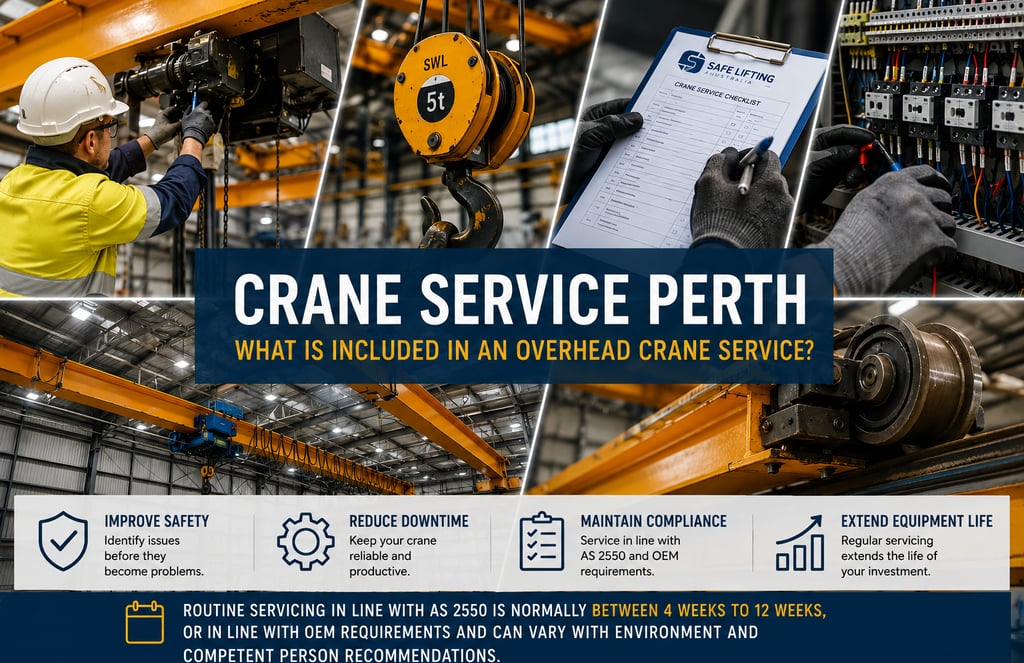
Crane Service Perth – How Often Should an Overhead Crane Be Serviced?
One of the most common questions we receive from crane owners and maintenance managers is:
"How often should my overhead crane be serviced?"
The answer depends on several factors including crane utilisation, duty classification, operating environment, manufacturer requirements and the recommendations of a competent person. There is alot of misinformation out there even by crane compnaies that dont seem to be aware of what is required.
Many people are surprised to learn that crane servicing, inspections and major inspections are all different activities with different requirements under Australian Standards.
This guide explains the various service and inspection requirements for overhead cranes and hoists in accordance with AS 2550.3 and industry best practice.
Understanding the Different Types of Crane Inspections and Services
AS 2550.3 identifies several levels of maintenance and inspection, each serving a different purpose.
These include:
Pre-operational inspections
Routine maintenance services
Periodic inspections
Third-party inspections
Major inspections
Assessments for continued safe operation
Each plays an important role in ensuring a crane remains safe, compliant and reliable throughout its service life.
Pre-Operational Inspections
Pre-operational inspections should be conducted before the commencement of each work shift.
These inspections are generally performed by the crane operator and focus on identifying obvious safety concerns before the crane is used.
Typical checks include:
Operating controls
Emergency stops
Brakes
Safety switches and interlocks
Travel and hoist limits
Wire ropes
Hooks and lifting attachments
Signage and warning labels
Leaks from gearboxes or hydraulic systems
Review of any defects recorded in the logbook
Any safety-related issues identified during these inspections should be addressed before the crane is returned to service.
Routine Maintenance Services
Routine maintenance is designed to keep the crane operating safely and reliably while reducing wear and preventing breakdowns.
Routine servicing commonly includes:
Lubrication of moving components
Inspection of wire ropes and sheaves
Brake adjustment and testing
Electrical contactor inspections
Inspection of safety devices and interlocks
Checking fluid levels where applicable
Inspection of control systems
Verification of warning labels and signage
Inspection of wear components
AS 2550.3 states that routine maintenance should generally not exceed three months between services unless the crane is out of service.
In practice, many overhead cranes throughout Perth are serviced at intervals between four and twelve weeks depending on utilisation, environment and competent person recommendations.
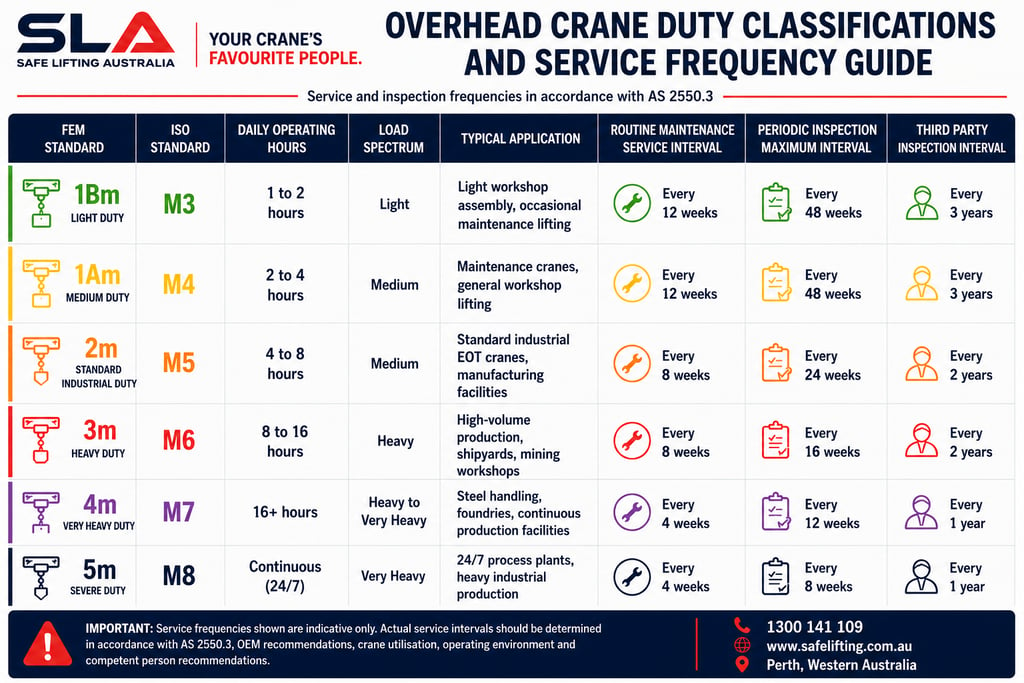
How Duty Classification Affects Service Frequency
Crane service intervals are often influenced by the crane's duty classification.
Duty classifications consider:
Operating hours
Frequency of lifting
Load spectrum
Operating environment
The most commonly used classifications are FEM and ISO classifications.
FEM 1Cm / ISO M3 – Light Duty
These cranes are typically used for light workshop activities and assembly operations.
Typical characteristics include:
One to two operating hours per day
Light loads
Infrequent lifting operations
Routine maintenance is generally performed every twelve weeks.
FEM 1Dm / ISO M4 – Medium Duty
These cranes are commonly used for maintenance activities and general workshop lifting.
Typical characteristics include:
Two to four operating hours per day
Moderate lifting frequency
Medium load spectrum
Routine maintenance is generally performed every twelve weeks.
FEM 2m / ISO M5 – Standard Industrial Duty
This is one of the most common classifications found in Australian industry.
Typical applications include:
Fabrication workshops
Manufacturing facilities
Warehouses
General industrial overhead cranes
These cranes typically operate between four and eight hours per day.
Routine maintenance is commonly carried out every eight weeks.
FEM 3m / ISO M6 – Heavy Duty
Heavy-duty cranes are commonly found in:
Mining workshops
Shipyards
Heavy manufacturing facilities
High-volume production environments
These cranes typically operate between eight and sixteen hours per day.
Routine maintenance is generally carried out every eight weeks.
FEM 4m / ISO M7 – Very Heavy Duty
These cranes are commonly used in demanding industrial applications including:
Steel handling
Foundries
Continuous production facilities
Operating hours often exceed sixteen hours per day.
Routine maintenance is commonly performed every four weeks.
FEM 5m / ISO M8 – Severe Duty
These cranes operate in some of the most demanding applications.
Typical examples include:
Continuous process plants
24-hour production facilities
Heavy industrial operations
Routine maintenance is generally carried out every four weeks.
Periodic Inspections
Periodic inspections are more detailed than routine maintenance services.
These inspections focus on determining whether critical components can safely remain in service until the next inspection interval.
Periodic inspections commonly include:
Structural components
Brakes
Gears
Fasteners
Pins and shafts
Wire ropes
Sheaves
Couplings
Electrical systems
Safety devices
Mechanical interlocks
The inspection interval depends on crane classification and operating conditions.
For heavily utilised cranes, periodic inspections may be required several times per year.
Third-Party Inspections
Third-party inspections provide an independent assessment of crane condition and compliance.
These inspections typically involve a review of:
Maintenance records
Repair history
Mechanical systems
Electrical systems
Structural components
Operational condition
Third-party inspections provide confidence that maintenance programs are effective and that the crane remains suitable for continued operation.
Depending on crane classification and site requirements, third-party inspections may be conducted annually or at longer intervals.
Many Perth industrial sites elect to undertake annual third-party inspections regardless of classification.
Major Inspections
Major inspections are significantly more comprehensive than routine servicing or periodic inspections.
A major inspection may include:
Detailed structural assessment
Mechanical assessment
Electrical assessment
Operational history review
Thickness testing
Corrosion assessment
Wear measurement
Non-destructive testing (NDT)
Detailed examination of critical components
Major inspections assist in determining whether a crane remains suitable for continued safe use.
10-Year and 25-Year Crane Inspections
One area often misunderstood by crane owners is the requirement for continued safe operation assessments.
AS 2550.3 states that cranes reaching the end of their design life should be assessed to confirm suitability for continued operation.
Where the design life is unknown, the Standard recommends:
Mechanical assessments at ten-year intervals
Structural assessments at twenty-five-year intervals
These assessments are commonly referred to as:
10-Year Crane Inspections
25-Year Crane Inspections
Continued Safe Use Assessments
These inspections are typically supervised by a professional engineer and may include major inspections, engineering assessments and NDT.
Factors That May Require More Frequent Servicing
Not all cranes operate under the same conditions.
More frequent servicing may be required where cranes operate in:
Mining environments
Marine and offshore environments
Ports and ship-loading facilities
Corrosive environments
High-cycle manufacturing facilities
Heavy-duty applications
Multi-shift operations
A competent person may recommend increased service frequencies based on actual crane condition and usage.
Common Misconceptions About Crane Servicing
"Annual inspections are enough."
Routine servicing, periodic inspections and major inspections are separate requirements and serve different purposes.
"The crane still works, so it doesn't need servicing."
Many critical defects are not visible to operators and are only identified during maintenance inspections.
"Servicing and third-party inspections are the same thing."
Routine servicing, periodic inspections and independent third-party inspections all have different objectives and requirements.
Need Crane Servicing in Perth?
Safe Lifting Australia provides overhead crane servicing, inspections and repairs throughout Perth and regional Western Australia.
Our services include:
Routine crane servicing
Periodic inspections
Third-party inspections
10-Year Crane Inspections
25-Year Crane Inspections
Engineering assessments
Load testing
Crane repairs and upgrades
Marine and offshore crane services
Whether you operate a light-duty workshop crane or a heavy-duty industrial crane, our experienced team can help ensure your equipment remains safe, compliant and reliable.
☎ 1300 141 109
☎ +61 1300 141 109 (International)
✉ service@safelifting.com.au
Inspection, maintenance, engineering, training and lifting solutions across Australia.
Explore Our Services
ABN: 85 674 428 098


GLOBAL OPERATIONS
Safe Lifting Australia Pty Ltd
Crane Inspection, Certification & Engineering Support
Across Australia and the Asia-Pacific Region - Over 100 Years Combined Crane & Lifting Industry Experience
☎ 1300 141 109
☎ +61 1300 141 109 (International)
✉ service@safelifting.com.au
Head Office Perth, Western Australia
Directors
Matt Weight - 0473 874 474
Dan Curchin - 0439 094 755
TRUSTED TO PERFORM IN HEAVY INDUSTRY
© 2026 Safe Lifting Australia Pty Ltd
All Rights Reserved
ISO 9001:2015 Certified | LEEA Member | Offshore & Overhead Crane Specialists
Projects completed across mining, offshore, defence and industrial sectors.



