
Crane Service Perth – What Is Included in an Overhead Crane Service?
Regular crane servicing not only helps maintain compliance with Australian Standards but also reduces breakdowns, improves safety and extends the service life of expensive equipment.
Matt Weight
6/14/20263 min read
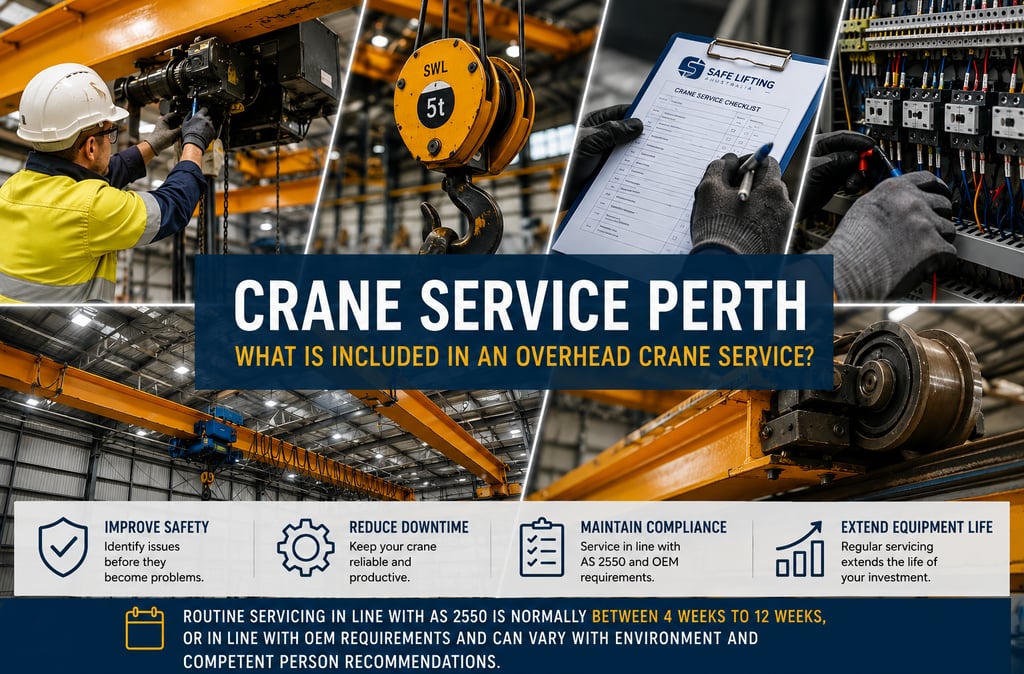
Crane Service Perth – What Is Included in an Overhead Crane Service?
Overhead cranes are critical assets in workshops, manufacturing facilities, warehouses, ports, mining operations and industrial sites throughout Perth and Western Australia. Regular crane servicing not only helps maintain compliance with Australian Standards but also reduces breakdowns, improves safety and extends the service life of expensive equipment.
One of the most common questions we receive at Safe Lifting Australia is:
"What is actually included in an overhead crane service?"
In this article, we explain what a professional crane service involves, how often cranes should be serviced, and the common defects identified during routine inspections. An inspection may be a more appropriate term for people to understand what occurs during the service alhtough minor adjustmnets and lubrication are often included.
Why Is Crane Servicing Important?
Overhead cranes operate under significant loads and are subjected to continual wear on mechanical, electrical and structural components.
Routine servicing helps:
Identify defects before they become failures
Reduce unplanned downtime
Improve workplace safety
Extend crane and hoist lifespan
Maintain compliance with Australian Standards
Reduce long-term repair costs
A relatively minor issue such as a worn wire rope or brake adjustment can often be corrected during a routine service. If left unattended, the same defect can lead to costly repairs, extended downtime or safety risks.
What Is Included in an Overhead Crane Service?
The scope of service varies depending on the crane type, age and duty cycle. However, a typical overhead crane service includes inspection and maintenance of the following components.
1. Wire Rope Inspection
Wire ropes are inspected for:
Broken wires
Corrosion
Birdcaging
Crushing
Kinking
Diameter reduction
Lubrication condition
Wire rope defects are among the most common issues found during crane servicing and should be addressed before they affect safe lifting operations.
2. Hook Block and Hook Assembly Inspection
The hook assembly is inspected for:
Wear
Cracks
Deformation
Safety latch condition
Bearing operation
Rotation performance
Hook throat openings and wear dimensions may also be checked against manufacturer recommendations.
3. Hoist Brake Inspection
The hoist brake is one of the most important safety components on any crane.
Technicians inspect:
Brake adjustment
Brake wear
Holding performance
Oil contamination
Brake coil condition
Response during operation
Brake defects should be addressed immediately as they can affect load control and safety.
4. Gearboxes and Drives
Gearboxes and drive systems are checked for:
Oil leaks
Excessive noise
Abnormal vibration
Wear
Alignment issues
Coupling condition
Early detection of gearbox issues can prevent major failures and expensive replacements.
5. Wheels and End Carriages
Bridge and gantry crane wheels are inspected for:
Wheel wear
Flange wear
Rail alignment issues
Loose fasteners
Structural defects
Poor wheel condition can result in crane skewing, rail damage and increased mechanical wear.
6. Electrical Inspection
Electrical systems are inspected for:
Damaged wiring
Loose terminals
Contactor wear
Emergency stop operation
Isolation systems
Control transformers
Earth continuity
Electrical faults are often identified before they cause operational failures.
7. Pendant and Remote Controls
Control systems are inspected for:
Button operation
Cable damage
Strain relief condition
Labelling
Emergency stop functionality
Remote control systems may also be tested to ensure reliable operation.
8. Festoon Systems and Conductor Systems
Technicians inspect:
Festoon trolleys
Flat cables
Conductor bars
Collector shoes
Junction boxes
Cable support systems
These components experience continual movement and are common wear items.
9. Limit Switches
Limit switches are tested to ensure correct operation.
This may include:
Upper hoist limits
Lower hoist limits
Travel limits
Rotary limits
Limit switches are critical for preventing over-travel and equipment damage.
10. Structural Inspection
The crane structure is visually inspected for:
Cracking
Corrosion
Impact damage
Missing fasteners
Structural deformation
Weld defects
Any concerns may require further engineering assessment or NDT inspection.
Common Defects Found During Crane Servicing
Some of the most common defects identified during routine servicing include:
Worn wire ropes
Missing/damaged hook safety latches
Brake adjustment issues
Damaged pendant cables
Worn collector shoes
Oil leaks
Electrical limit faults
Wheel wear
Electrical control faults
Missing labels and signage
Identifying these issues early significantly reduces repair costs and downtime.
How Often Should an Overhead Crane Be Serviced?
Service frequency depends on crane usage, environment and duty classification.
Typical service intervals include:
4 weekly inspections for heavily utilised cranes
12 weekly/Quarterly servicing for moderate duty cranes
Annual inspections in accordance with Australian Standards
High-cycle cranes used in mining, manufacturing and process facilities often require more frequent servicing.
Australian Standards for Crane Servicing
Crane servicing and maintenance should be conducted in accordance with relevant Australian Standards, including:
AS 2550.1 – Cranes, Hoists and Winches – Safe Use
AS 2550.3 – Bridge, Gantry, Portal and Container Cranes
AS 1418 Series – Cranes, Hoists and Winches
Manufacturer maintenance requirements
Maintaining service records is also important for demonstrating compliance and supporting future major inspections.
Crane Service vs Crane Inspection – What Is the Difference?
A crane service focuses on maintenance activities such as adjustments, lubrication and component checks.
A crane inspection focuses on assessing compliance, safety and equipment condition.
Most facilities benefit from combining routine servicing with scheduled annual/third party inspections to maximise reliability and compliance.
Why Choose Safe Lifting Australia?
Safe Lifting Australia provides crane servicing, inspections and repairs throughout Perth and regional Western Australia.
Our services include:
Routine crane servicing
Breakdown support
Annual inspections
Major 10-year and 25-year inspections
Crane repairs and upgrades
Engineering assessments
Load testing
Marine and offshore crane services
Our experienced technicians work across bridge cranes, gantry cranes, jib cranes, monorails, electric chain hoists and specialised lifting equipment.
Need Crane Servicing in Perth?
If your overhead crane requires servicing, inspection or repairs, contact Safe Lifting Australia today.
Our team provides responsive support throughout Perth, Geraldton, Bunbury, Kalgoorlie, Karratha, Port Hedland and regional Western Australia.
☎ 1300 141 109
☎ +61 1300 141 109 (International)
✉ service@safelifting.com.au
Inspection, maintenance, engineering, training and lifting solutions across Australia.
Explore Our Services
ABN: 85 674 428 098


GLOBAL OPERATIONS
Safe Lifting Australia Pty Ltd
Crane Inspection, Certification & Engineering Support
Across Australia and the Asia-Pacific Region - Over 100 Years Combined Crane & Lifting Industry Experience
☎ 1300 141 109
☎ +61 1300 141 109 (International)
✉ service@safelifting.com.au
Head Office Perth, Western Australia
Directors
Matt Weight - 0473 874 474
Dan Curchin - 0439 094 755
TRUSTED TO PERFORM IN HEAVY INDUSTRY
© 2026 Safe Lifting Australia Pty Ltd
All Rights Reserved
ISO 9001:2015 Certified | LEEA Member | Offshore & Overhead Crane Specialists
Projects completed across mining, offshore, defence and industrial sectors.



